What wonderful opening of the symposium ” Beyond the Toolkit”!
It has been a great afternoon of meeting people who are going to give talks and workshops tomorrow in the context of the symposium.
I am very grateful for Fiona Hackney and her team who created this amazing event and cast the net to bring so many people together; people who bring their keen interest in the relationship of Craft and Wellbeing to this event and share their ideas, stories and experiences.
One of tonight’s speakers was Monika Auch, a visual artist and medical researcher. More about her work and her project “Stitch your Brain” tomorrow !!!
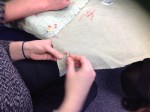
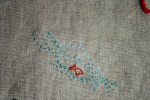
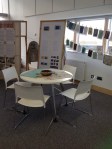
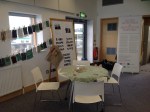
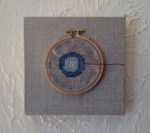
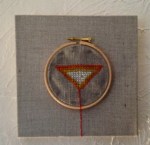
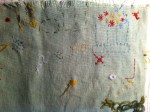
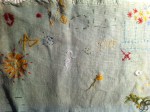
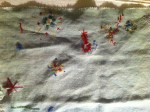
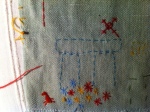
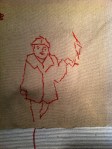
“Time and Stitch ” is on the road again! This time my work is on show at the ‘Beyond the Toolkit’ Symposium (19./20. Feb.2014, University Falmouth, Air Building) And again there will be the opportunity to add a stitch or two to the cloth, which becomes richer with every outing!”Time and Stitch ” is on the road again! This time my work is on show at the ‘Beyond the Toolkit’ Symposium (19./20. Feb.2014, University Falmouth, Air Building) And again there will be the opportunity to add a stitch or two to the cloth, which becomes richer with every outing!
I was invited by Ilker Cinarel to take part in the exhibition:
INNterval – An artistic collaboration at the Halsetown Inn – a tribute to the legacy of J.Henry Irving.
The Halsetown Inn, 2nd / 8th February 2014
It was a mixed media show, ranging from painting, drawing, sculpture, video, photography and Embroidery!
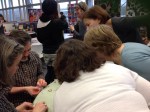
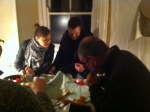
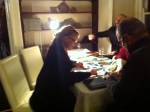
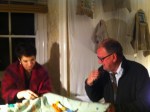
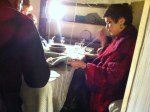
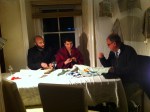
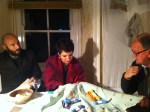
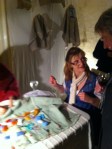
It was a wonderful night for me, as right from the beginning of the private view till the end people were gathering around the table and started stitching. As a space became free, someone new joined in!
When I was talking to people, I noticed the joy and pleasure, they took out of this rather unexpected opportunity in the context of an otherwise conceptual exhibition setting. It was interesting to watch people stitching and talking, with great intensity!
I am very thankful to Ilker Cinarel, for the opportunity to show my work and to all the people who became participants in the Joy of Stitch!
There is the slow food movement, coined by Carlo Petrini, which emphasizes the return to fresh, locally sourced and unprocessed food. Slow food focuses on the simple pleasures of a home-cooked meal and the sense of community that is cultivated when we sit down together to share a meal. It is not a coincidence that since the coining of the term, “slow food,” we now see a number of similar terms such as “slow parenting” and “slow travel.” The slow movement speaks to a desire to forge connections that have been severed by the rapidity of the internet age, and it reflects the impulse to find sustainable ways to live in the face of consumerism, globalization and environmental degradation.
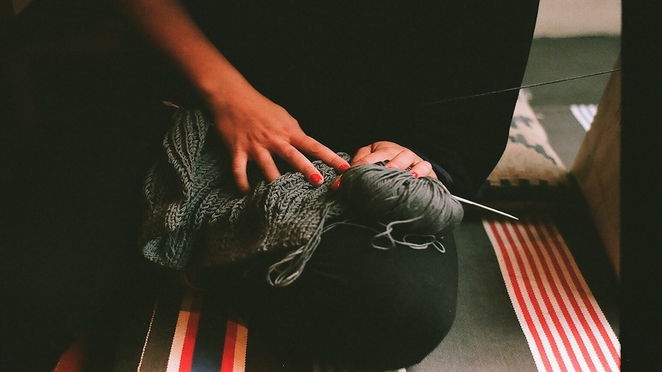
I’ve started knitting again after a year-long break. I bought some beautiful hand-dyed, locally spun yarn in a brilliant mottled fuchsia, and then I got to work, knitting furiously for two days straight until I realized that my new infinity scarf was disproportionately huge. I had to undo everything and start over, my enthusiasm somewhat dampened.
When I took my knitting to a friend’s house, someone asked an interesting question: “Why would you bother knitting a scarf? It’s so much work and you can buy a great scarf for cheap anywhere.” It’s a good question. If it’s easy to buy a decent scarf for $10 at H&M, why would I spend $50 on handspun yarn and another week of knitting in order to get a finished product? It’s hardly economical.
But there’s more to it than that. The act of knitting is a strange combination of relaxation and activism, of protest and tradition. My urge to pick it up again started last month after reading Overdressed: The Shockingly High Cost of Cheap Fashion by Elizabeth Cline. (You can read my review here.) The author pushes for a “slow clothes” movement, the fashion equivalent of “slow food,” in which consumers start paying attention to the background of their clothes and what has gone into their production. Knitting is my small contribution to the slow clothes movement for the following reasons:
I’m creating a product of high quality. Because I’ve invested money and time into this scarf, it is far more valuable than anything I could buy for $10. I will care for it and it will last for many years, keeping its shape and colour long after cheaper scarves have fallen apart. Clothing is devalued in North America to the point where it’s practically disposable. It would be far better for the Earth if we stopped buying cheap items that don’t last and invested in fewer, higher quality items that do last.
Knitting is a way to reclaim independence. We live in a world where we depend on certain individuals and companies to perform highly specialized tasks for us. There’s something satisfying about taking on some of the responsibility for clothing production and sending a message to the industry that I don’t need them to make my scarves.
Knitting can help a local industry. It wasn’t cheap to buy two skeins of that locally produced yarn, but at least I’m making a statement with my consumer dollars to a nearby farmer, endorsing his or her decision to make a living raising sheep. According to Cline, if every American redirected 1 percent of their disposable income to domestically-made products, it would create 200,000 jobs. Cheap imported clothes become a lot more expensive when you calculate the loss of domestic jobs.
Finally, it feels really good to make something by hand. There’s something very peaceful about performing a simple, repetitive act with my fingers that results in useful yet beautiful things.
Do you knit or have another ‘slow clothes’-related hobby?



























 One Stitch at Time