Sustainability, Wellbeing, Mindfullness and Textile Creativity are informing my Artist' Practice.
The daily making as a means in it self and the sharing through workshops, classes and art projects.
You find under my hands, handspinning with British Wool, Slow Embroidery, Knitting, crochet, nalebinding, braiding and small scale weaving. Natural dying with seasonal and local colours, experimenting with Woad and Indigo Dying are heaping as and when possible.
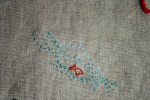
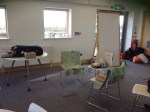
“Time and Stitch ” is on the road again! This time my work is on show at the ‘Beyond the Toolkit’ Symposium (19./20. Feb.2014, University Falmouth, Air Building) And again there will be the opportunity to add a stitch or two to the cloth, which becomes richer with every outing!”Time and Stitch ” is on the road again! This time my work is on show at the ‘Beyond the Toolkit’ Symposium (19./20. Feb.2014, University Falmouth, Air Building) And again there will be the opportunity to add a stitch or two to the cloth, which becomes richer with every outing!
I was invited by Ilker Cinarel to take part in the exhibition:
INNterval – An artistic collaboration at the Halsetown Inn – a tribute to the legacy of J.Henry Irving.
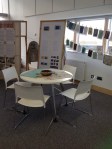
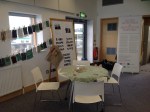
The Halsetown Inn, 2nd / 8th February 2014
It was a mixed media show, ranging from painting, drawing, sculpture, video, photography and Embroidery!
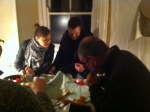
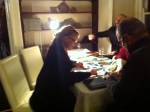
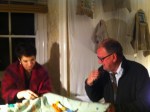
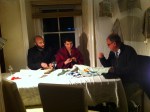
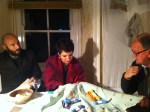
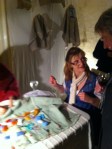
It was a wonderful night for me, as right from the beginning of the private view till the end people were gathering around the table and started stitching. As a space became free, someone new joined in!
When I was talking to people, I noticed the joy and pleasure, they took out of this rather unexpected opportunity in the context of an otherwise conceptual exhibition setting. It was interesting to watch people stitching and talking, with great intensity!
I am very thankful to Ilker Cinarel, for the opportunity to show my work and to all the people who became participants in the Joy of Stitch!
There is the slow food movement, coined by Carlo Petrini, which emphasizes the return to fresh, locally sourced and unprocessed food. Slow food focuses on the simple pleasures of a home-cooked meal and the sense of community that is cultivated when we sit down together to share a meal. It is not a coincidence that since the coining of the term, “slow food,” we now see a number of similar terms such as “slow parenting” and “slow travel.” The slow movement speaks to a desire to forge connections that have been severed by the rapidity of the internet age, and it reflects the impulse to find sustainable ways to live in the face of consumerism, globalization and environmental degradation.
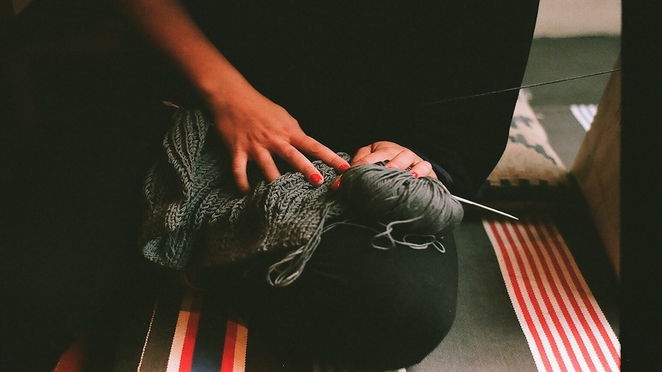
I’ve started knitting again after a year-long break. I bought some beautiful hand-dyed, locally spun yarn in a brilliant mottled fuchsia, and then I got to work, knitting furiously for two days straight until I realized that my new infinity scarf was disproportionately huge. I had to undo everything and start over, my enthusiasm somewhat dampened.
When I took my knitting to a friend’s house, someone asked an interesting question: “Why would you bother knitting a scarf? It’s so much work and you can buy a great scarf for cheap anywhere.” It’s a good question. If it’s easy to buy a decent scarf for $10 at H&M, why would I spend $50 on handspun yarn and another week of knitting in order to get a finished product? It’s hardly economical.
But there’s more to it than that. The act of knitting is a strange combination of relaxation and activism, of protest and tradition. My urge to pick it up again started last month after reading Overdressed: The Shockingly High Cost of Cheap Fashion by Elizabeth Cline. (You can read my review here.) The author pushes for a “slow clothes” movement, the fashion equivalent of “slow food,” in which consumers start paying attention to the background of their clothes and what has gone into their production. Knitting is my small contribution to the slow clothes movement for the following reasons:
I’m creating a product of high quality. Because I’ve invested money and time into this scarf, it is far more valuable than anything I could buy for $10. I will care for it and it will last for many years, keeping its shape and colour long after cheaper scarves have fallen apart. Clothing is devalued in North America to the point where it’s practically disposable. It would be far better for the Earth if we stopped buying cheap items that don’t last and invested in fewer, higher quality items that do last.
Knitting is a way to reclaim independence. We live in a world where we depend on certain individuals and companies to perform highly specialized tasks for us. There’s something satisfying about taking on some of the responsibility for clothing production and sending a message to the industry that I don’t need them to make my scarves.
Knitting can help a local industry. It wasn’t cheap to buy two skeins of that locally produced yarn, but at least I’m making a statement with my consumer dollars to a nearby farmer, endorsing his or her decision to make a living raising sheep. According to Cline, if every American redirected 1 percent of their disposable income to domestically-made products, it would create 200,000 jobs. Cheap imported clothes become a lot more expensive when you calculate the loss of domestic jobs.
Finally, it feels really good to make something by hand. There’s something very peaceful about performing a simple, repetitive act with my fingers that results in useful yet beautiful things.
Do you knit or have another ‘slow clothes’-related hobby?
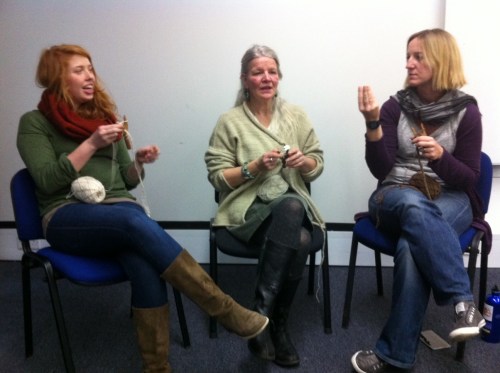
Vicky, Christiane and Claire working with a Lucette
Some years ago, during the annual “Woolfest” in Cockermouthnear Carlisle, I found at the stand off the Mulberry Dyer (http://www.mulberrydyer.co.uk/) a tool called ‘Lucette’.
Lucite
This tool predates French Knitting and was used for braiding a wide range of everyday items.
In my research on the internet I found a very interesting range of design, some with a handle, some without like the one above.
From Wikipedia, the free Encyclopaedia
A lucet is a tool used in cord making or braiding which is believed to date back to the Viking[1] and Medieval[2] periods, when it was used to create cords that were used on clothing,[1]or to hang items from the belt.[3][4] Lucet cord is square, strong, and slightly springy. It closely resembles knitted I-cord or the cord produced on a knitting spool. Lucet cord is formed by a series of loop like knots, and therefore will not unravel if cut. Unlike other braiding techniques such as kumihimo, finger-loop braiding or plaiting, where the threads are of a finite length, lucetted braids can be created without pre-measuring threads and so it is a technique suited for very long cords.
Archaeological finds and a literary description of lucets strongly suggest that its use declined after the 12th century,[2] but was revived in the 17th century.[5] Its use waned again in the early 19th century.[4]
A modern lucet fork, like that pictured, is normally made of wood, with two prongs at one end and a handle on the other. It may also have a hole through which the cord can be pulled. Medieval lucets, in contrast, appear to be double-pronged, straight-sided implements, often made of bone.[6] Some were shaped from hollowed bones, left tubular, presumably so that the cord could be drawn through the centre hole.[2]
In a seminar, where we were asked to show an example of our practice, I decided to demonstrate how to use a Lucette.
Two of my fellow students, Claire and Vicky agreed to volunteer and received a crash course in “lucetting”!!!
We used wool from the Vicarage Farm in Penryn, which I had bought some time ago at the Falmouth Farmers Market.
My two volunteers learned the trick of the trade very quickly and enjoyed the new techniques.
I was inspired by the artist Francoise Dupre, whose work incorporates French knitting and participation.
Participation and FRench KnittingInterview with Francoise DupreFrancoise Dupre, SpiralIrish Knitting at the Musuem in Dublin
de fil en aiguille snaith nasc, 2004 French knitting, Four needle knitting, Irish knitting stitches, wide range of yarns including plastic, cotton and wool and digital prints
Installation at the Irish Museum of Modern Art, Dublin
The project is based on social interaction and creative collaboration between artist and participants. The design of the installation is inspired by the Museum Formal Garden and Irish knitting.
-Floor piece: 4m x 4m x 10cm-
-Wall piece: 209 video stills, 6cm x 4.5cm-
-Mixed yarns and digital prints-
Every day, in newspapers and on television, we read and hear about the ongoing destruction of the environment: the greenhouse effect, ozone layer depletion, deforestation, and air and water pollution. Deep Ecology offers a solution to the environmental crisis through a radical shift in human consciousness—a fundamental change in the way people relatewith the environment. Instead of thinking of nature as a resource to be used for human needs, Deep Ecology argues that the true value of nature is intrinsic and independent of its utility. Emerging in the 1980s as an influential philosophical, social, and political movement, Deep Ecology has shaped the environmental debate among leading activists and policymakers—from former Vice-President Al Gore to Dave Forman, cofounder of Earth First!Deep Ecology for the Twenty-First Century contains thirty-nine articles by the leading writers and thinkers in the filed, offering a comprehensive array of perspectives on this new approach to environmentalism, exploring:• The basic philosophy of Deep Ecology.
• Its roots in the writings of Henry David Thoreau, John Muir and Rachel Carson.
• The relationship of Deep Ecology to social ecology, ecofeminism, the Greens, and New Age futurism.
• How Deep Ecology as a way of life is exemplified by two important environmentalists: poet Gary Snyder and Norwegian philosopher Arne Naess.
• The philosophical dimensions of this environmental movement by its leading theorist.
• The politics of ecological sustainability and the social and political implications of Deep Ecology for the next century.
Ecofeminist Natures:
Race, Gender, Feminist Theory, and Political Action
Examining the development of ecofeminism from the 1980s antimilitarist movement to an internationalist ecofeminism in the 1990s, Sturgeon explores the ecofeminist notions of gender, race, and nature. She moves from detailed historical investigations of important manifestations of US ecofeminism to a broad analysis of international environmental politics.
Race, Gender, Feminist Theory, and Political Action
Indiana University Press, 1996 – Social Science – 270 pages
Here feminist philosophers and ecofeminist scholars pursue the connections between feminism and environmentalism. Topics include the ecofeminist ethic; the role of patriarchal concepts in perpetuating the domination of women and nature; the grassroots origins and character of a thoughtful ecofeminism; the “ecofeminism-deep ecology debate” in environmental philosophy; deep ecological treatment of animal rights and the omission of ecofeminist analyses of the domination of animals, abortion, and nuclear deterrence; and ways ecofeminism and the science of ecology are or could be engaged in complementary, supportive projects.
The contributors are Carol J. Adams, Carol H. Cantrell, Jim Cheney, Chris Cuomo, Deane Curtin, Victoria Davion, Roger J. H. King, Stephanie Lahar, Patricia Jagentowicz Mills, Patrick D. Murphy, Val Plumwood, Catherine Roach, Robert Sessions, Deborah Slicer, and Karen J. Warren.
Women healing earth:
Third World women on ecology, feminism, and religion
Drawing on the insights of ecology, feminism, and socialism, ecofeminism’s basic premise is that the ideology that authorizes oppression based on race, class, gender, sexuality, physical abilities, and species is the same ideology that sanctions the oppression of nature. In this collection of essays, feminist scholars and activists discuss the relationships among human begins, the natural environment, and nonhuman animals. They reject the nature/culture dualism of patriarchal thought and locate animals and humans within nature. The goal of these twelve articles is to contribute to the evolving dialogue among feminists, ecofeminists, animal liberationists, deep ecologists, and social ecologists in an effort to create a sustainable lifestyle for all inhabitants of the earth. Among the issues addressed are the conflicts between Green politics and ecofeminism, various applications of ecofeminist theory, the relationship of animal liberation to ecofeminism, harmful implications of the romanticized woman-nature associationin Western culture, and cultural limitations of ecofeminism.
Indiana University Press, 22 May 1997 – Nature – 472 pages
“… provides readers with a much-needed cross-cultural and multidisciplinary perspective on ecofeminist activism and scholarship.” — Iris
“… a very important contribution to the literature on ecological feminism.” — Ethics
“I think the unique collection of so many different perspectives will help to push readers out of their disciplinary views and work to bring theory and practice together in meaningful ways…. an excellent resource for scholars and teachers…” — Teaching Philosophy
Here the potential strengths and weaknesses of the growing ecofeminist movement are critically assessed by scholars in a variety of academic disciplines and vocations, including anthropology, biology, chemical engineering, education, political science, recreation and leisure studies, sociology, and political organizing.
This is a book about simplicity – not destitution, parsimoniousness or self-denial, but the restoration of wealth in the midst of an afflence in which we are starving the spirit. It is a book about the advantages of living a less cluttered, less stressful life than that which has become the norm in the overcrowded and manic-paced consuming nations. It is a book about having less and enjoying more, enjoying time to do the work you love, enjoying time to spend with your family, enjoying time to pursue creative projects, enjoying time for good eating, enjoying time just to be.
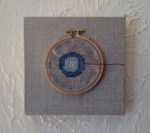
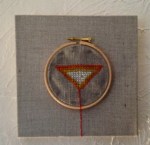
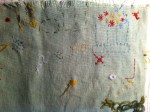
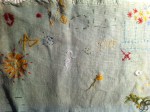
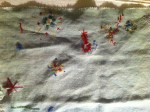
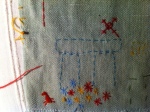
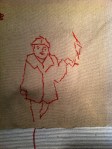
Here are the first glimpses from the Graduation show! what pleases me most, is that people have been in acting with the embroidery and added their stitches to the large cloth which was started at the Event at the Exchange, Penzance.
Soon there will be more photos and reflective writing. The Show comes down on Friday, 21. June.



























 Rope bracelet


 One Stitch at Time