The Joy of Stitch

Sea, Wind Embroidery and Muisc

A moment of being out in the elements, the wind, the sounds, the feel of the rocks under my body: sitting still, taking it all in, stitching the experience into the fabric in my hands.

Sea, Wind, Embroidery and Music

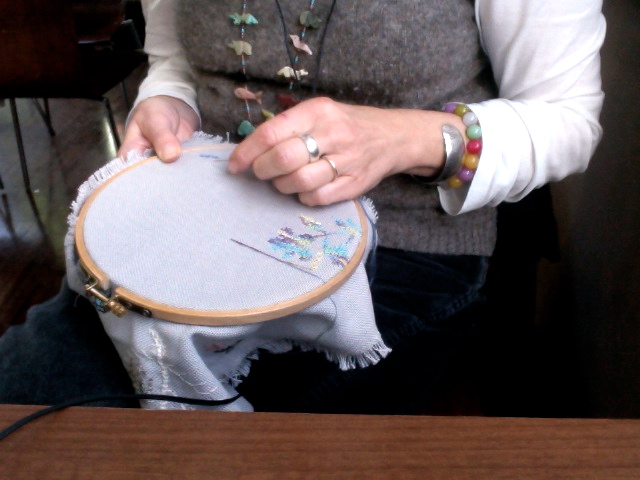
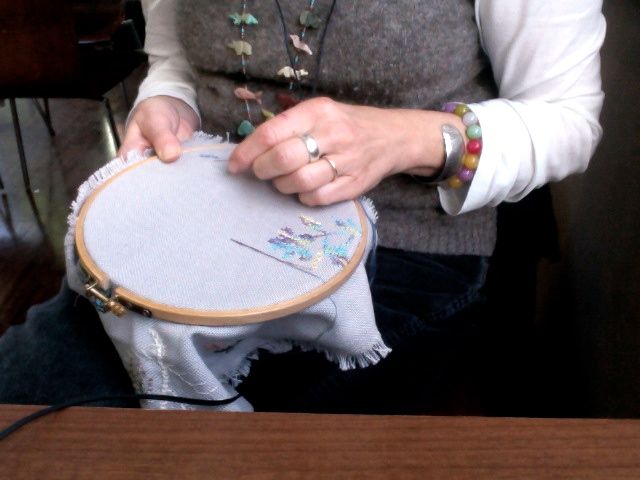
It was my first outing with my Embroidery into the landscape. it was a new experience to in the wind, to hear the sea crashing and the gulls crying above; stitching in my awareness of place, a place close to my home. The embroidery, the act of stitching is the inner place, space I long for. The Frame and the fabric become the space, to journey into. – filming requires collaboration, a dialoge with the person behind the camera (Thank you so much Bill!!) , it requires communication, taking out of my head my vision of what I am looking for. I enter a process with the person I am working with, there is a give and take, a exchange of ideas. – Music – the music is guitare improvisation by Bill Goodyear (thank you again for your time and input). It was recorded late in his flat during another filming session. Bill’s music becomes a audio anchor for my mind, my hands are moving and I am listing, entering a place of calm.


The Joy of Stitch

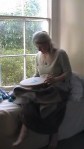
By the Window

It is always good to see the film clips and the stills on a big screen, I love my images, but I feel rather wobbly ,because it is so far out from what the “usual” edgy student work  is like.

In this way, being true to myself and my search to find ways to express with these images my longing for stillness, slow time, beauty, poetry, feels scary, exposed and risky. 

On the other hand I get reaction, that the work does look beautiful and reminds of Vermeer paintings.


The Joy of Stitch

Reflection on the Project Day at UCF Falmouth, Woodlane 03.12. 2012

I just want to share how’s it has been today at the college on our Projectday. 
It is a bit like note writing, but with someone listing.
It was good again seeing the clips on the wall, bigger.
My tutor is very supportive; the delicate working of the hands 
and the general minimal approach is one of the major aspects of this new work.S1270017
                                                                             Still from  “Church, Embroidery and Music”
Gillian Wylde suggested to do the shots again, both on tripods,
with out any zooming and using one camera, filming two positions
> one of the “Figur against the window”
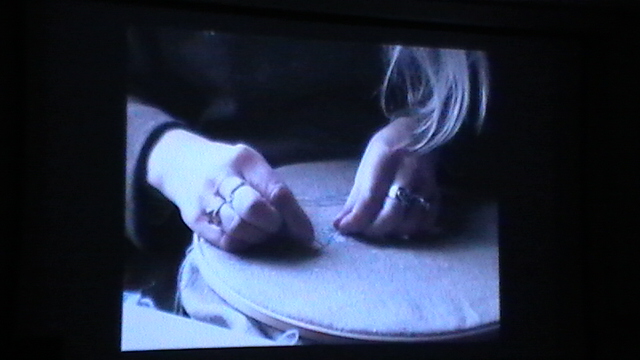
the other one concentrating in a close-up of the movement of the hands.
 
She also acknowledges that the music is an important part of it.
Nigel playing “Spiegel im Spiegel” (Arvo Paert) goes so well with the image,
it makes it into a whole piece, the way it is complementing it.
There is a consideration maybe be in recording the music separately.
 I don’t know at this moment in time, if it will be possible for Nigel to play for me again.
Nigel had said he would like to play or write some music for me.
 
I would like to go back into the church on the other side of Christmas, 
but I am also thinking if I could have a trial run in my house, 
using the the window on the stairs.  I need a tripod for that.
 
At the moment I have to think in alternatives. 
Also having to think about  having to approach other musicians.


Uncategorized

The Appletree Cafe Knitting Group

[vimeo http://www.vimeo.com/53324522 w=500&h=281] <p><a href=”http://vimeo.com/53324522″>The Appletree Cafe – Knitting Group</a> from <a href=”http://vimeo.com/user11511171″>Christiane Berghoff</a> on <a href=”http://vimeo.com”>Vimeo</a&gt;.</p>

On Thursday the 08 November I visited the Knitting Group at the Appletree Cafe in Sennen (Penwith, Cornwall). http://www.theappletreecafe.co.uk/

One of my previous students Susan Thomas (she is a retired occupational therapist) had told me about this group;

Susan likes this group because the members, to her mind, are more inventive, creating their own designs and  are more concerned about the material (quality of wool etc.) they are using.

I received a warm welcome and when I introduced myself and my intend to film them, while they were getting on with whatever they were doing, they were happy to let me get on with what I wanted to do.

It is an interesting group, some younger women, who were just beginning to learn to knit under the emphatic tuition of some of the more experienced knitters. It was a general, very animated, lively atmosphere, lots of laughter and friendly banter. 

In the middle of the table was a stack of books, some had brought along to share

At the end I talked with  the two women, who is organizing this group, Pat Furley and Jenny Strickland. 

Their business name “the unravelled sleave” is taken from a Shakespearquote: 

the raveled sleave’– a woven or threaded skein of yarn
Macbeth Act 2 Scene 2: ‘Methought I heard a voice cry “Sleep no more, Macbeth does murder sleep” – The innocent sleep that knits up the raveled sleave of care…….’

As it happens they had only recently thought about that it would be interesting to research  old knitting songs can be found.

It is known, that in a time when people, not only women would get together to spin, weave, embroider, sew and later knit that there were songs sung.

This is another thread to follow up for me!

Women like these, revive the tradition of women getting together, to be sociable, meet friends exchange knowledge, help each other out and teach the younger ones. 

There is something, where I can’t quite can put my finger on, why it makes such a difference when being in a group of women and making something with my hands, then rather sitting in a group of friends and chatting away. I am aware the the attention and mostly understated competitiveness in the groups is intriguing. To  receive praise for what is on the needles or around the shoulders is very encouraging and does makes one feel good about oneself.

But also the sympathetic support on receives when things goes inevitably wrong and some kind hand helps you to unravel the bit where one has gone wrong and helps you to pick up the stitches again. Just as we need it in life. 

Uncategorized

Embroidery in St. Church

On Saturday, Nigel and I went into St. Mary’s Church, Penzance in order to photograph two banners.Unfortunately I had “lost” the charger for my digital camera and the battery was flat, so we had to resort to a disposable camera!

the balcony
Midday light

While Nigel was sorting out some music (he is the organist) I walked around the balcony. I always loved this church, it feels warm and almost homely, slightly crumbling around the edges. It was around midday and the light came in from the east, soft and gentle, casting delicate shadows. I was taken by the gentle, calm atmosphere. Just stepping one thought back: somewhere in my work, not always obvious, was/is a search for incorporating an aspect of spirituality. I grew up in a Protestant church community and worked in Germany for 15 years for different protestant organizations. Since my early 20’s I have  been on my journey to find my own “spiritual” home. Spirituality is an important part of my life, not necessarily religious belief.  But being in this church and taking part in the church community has given me a physical space, a community and with that a kind of framework. This is only a beginning of a reflection, just a noting of first thoughts. It is less than two months since it has become part of my life again. While I was walking around, the church taking photos, the idea came to start with filming me in this space, embroidering, while listing to music.Working with Textiles has always these two aspects to it, the solitary retreat into something which comes close to meditation and the social situation of being in a group ( knitting groups, working with friends, etc.) At this moment it was the idea of capturing the reflective meditative moment.

Uncategorized

Tate Modern – The Tanks – Susanne Lacy

The Tanks Susanne Lacy

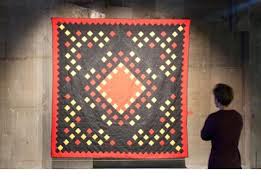
The main reason for my visit to the Tate Modern at the end of October was the Tank is showing Suzanne Lacey’s Crystal Quilt.

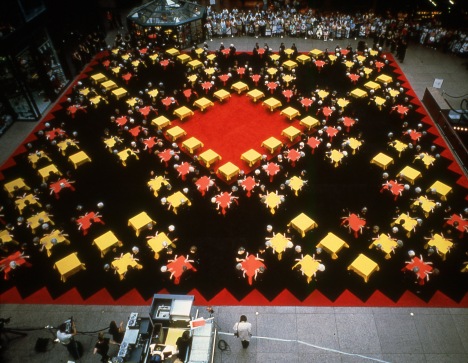
Suzanne Lacy’s The Crystal Quilt 19857 took place over three years in Minneapolis, Minnesota. A collaborative and public artwork, it explored how the media portrayed ageing and what the role for older people in public was. Incorporating many types of practice, from art exhibitions and lectures to community organising and a leadership seminar for older women, it culminated in a performance on Mother’s Day in 1987.

430 women aged over 60 from Minneapolis gathered together to perform in a live tableau, lasting an hour and broadcast live on a public television network. Staged on a series of tables laid out on a huge square rug (designed by the painter Miriam Schapiro), the performers sat four to a table, their hands laid on the coloured tablecloths changing at ten-minute intervals to echo the shapes of different quilt blocks (the quilt being an emblem of the traditional sharing of North American female experience). While the performers discussed their experiences and reminiscences, the audience also listened to a soundtrack by composer Susan Stone mixing the voices of 75 women talking about ageing – personal observations, their own memories, and sociological analysis of the unused potential of older people.

Lacy’s work has often been concerned with social issues, and about including and reaching particular audiences (in this case older women). She is a pioneer of inclusion and participation in her practice, with The Crystal Quilt consciously seeking to represent and include women form diverse ethnic and social backgrounds. She has also set out to deal with the place of art in society:

In some sense The Crystal Quilt was successful politically, in that the work was bigger, it had more social impact in that region, but do one or two events ever change the way people – other than those who directly experience it – see? This raises this issue of whether you can expect art to create social change, and at what point is it no longer art.

You can hear Suzanne Lacy speaking about this project at Inside/Outside: Materialising the Social at Tate Modern 21 July 2012

You can see documentation from Suzanne Lacy’s The Crystal Quilt on display in The Tanks at Tate Modern, 18 July – 28 October 2012

Susanne lacy’s work and writing have been very influential in the writing of my dissertation. I am still getting my head around social Interaction and Art.  Seeing the video  of the installation of the “Quilt” ((time-lapse video) and the real, physical quilt, which was designed by Miriam Shapiro and listing to the interview with Suzanne and the participants of “The Crystal Quilt” was very illuminating and touching.

Uncategorized

Tate Modern – Tino Sehgal – The Unilever Series

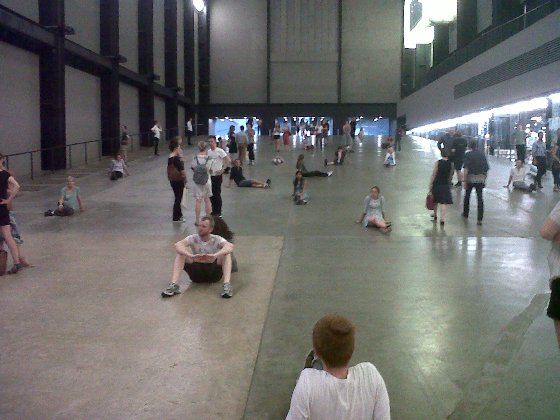
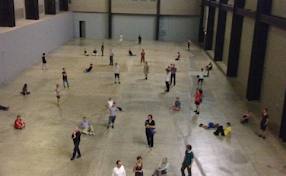
When I arrived in the Turbine hall, people were coming up, walking almost in slow motion. I didn’t quite realize at once I was walking through a performance art, it really didn’t register at that moment. After lunch, when my partner and me came back into the Turbine Hall we realized, that there was a performance going on; it was touching, mesmerizing to hear in this space suddenly  a kind of harmony singing and see people moving around, then talking to the audience. We went downstairs and observed more. A member of staff told me, that there is no documentation. Seghal intend is concerned with real-time encounter and communication. I couldn’t help but film a few minutes

Still

I will research the artist Seghal more, I only now so far, that he has taking parting in the Documenta in Kassel, Germany.

Uncategorized

A New Beginning

Embroidery

Today I had my first tutorial with Gillian Wylde, there is so much information to share and getting to know each other.It felt good, because I felt understood

This is the transfer from my mind map, unfortunatly I haven’t found out yet how to copy and past the grapphic as well, oh well, on step at a time!!!

The Beauty ot the Act of Hand Making

I.      The way is the goal, not the destination

A.   Documenting through Still Photography

II.     Zen as a stepping point towards a visual sensibility

A.   The Stillness and Beauty in Japanese Craft

III.    Multi-sensory experience 

A.   Touch of wool, fabric and yarn

B.   Sound> interplay and response in dialogue

C.   Visual

in real time and documentation (Film, Photography)

IV.    sharing of the experience > collaborative and participation

Gillian seemed to understand my multi layered approach:

– working on a real-time piece of embroidery,which will become a “companion” through out the process,

– my wish for collaboration with others through working together with photography and video,

– incorporating interdisciplinary collaboration with musicians

– and a parallel approach which shows solitude and being with other people as in :

> being myself  the antagonist, the person who creates through the retreat in to embroidery a reflective space in a fast, hectic world

> and creating situation in which I wish to share this with other, stitching in a public space and inviting other to share to work and my space for a short moment in time.

Gillian will email me links to artists and events for my conceptual research, she suggestes Ann Hamilton, Tom van Holland, Roni Lee and the “Mending Conference”


Becoming friends with me