I was invited by Ilker Cinarel to take part in the exhibition:
INNterval – An artistic collaboration at the Halsetown Inn – a tribute to the legacy of J.Henry Irving.
The Halsetown Inn, 2nd / 8th February 2014
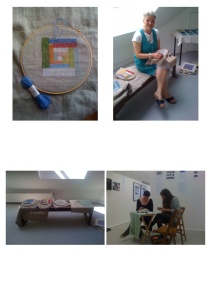
It was a mixed media show, ranging from painting, drawing, sculpture, video, photography and Embroidery!
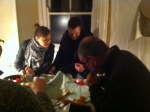
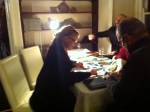
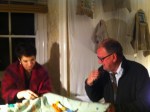
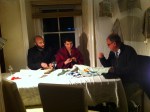
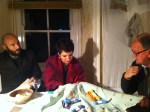
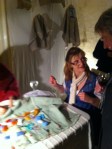
It was a wonderful night for me, as right from the beginning of the private view till the end people were gathering around the table and started stitching. As a space became free, someone new joined in!
When I was talking to people, I noticed the joy and pleasure, they took out of this rather unexpected opportunity in the context of an otherwise conceptual exhibition setting. It was interesting to watch people stitching and talking, with great intensity!
I am very thankful to Ilker Cinarel, for the opportunity to show my work and to all the people who became participants in the Joy of Stitch!
There is the slow food movement, coined by Carlo Petrini, which emphasizes the return to fresh, locally sourced and unprocessed food. Slow food focuses on the simple pleasures of a home-cooked meal and the sense of community that is cultivated when we sit down together to share a meal. It is not a coincidence that since the coining of the term, “slow food,” we now see a number of similar terms such as “slow parenting” and “slow travel.” The slow movement speaks to a desire to forge connections that have been severed by the rapidity of the internet age, and it reflects the impulse to find sustainable ways to live in the face of consumerism, globalization and environmental degradation.
I’ve started knitting again after a year-long break. I bought some beautiful hand-dyed, locally spun yarn in a brilliant mottled fuchsia, and then I got to work, knitting furiously for two days straight until I realized that my new infinity scarf was disproportionately huge. I had to undo everything and start over, my enthusiasm somewhat dampened.
When I took my knitting to a friend’s house, someone asked an interesting question: “Why would you bother knitting a scarf? It’s so much work and you can buy a great scarf for cheap anywhere.” It’s a good question. If it’s easy to buy a decent scarf for $10 at H&M, why would I spend $50 on handspun yarn and another week of knitting in order to get a finished product? It’s hardly economical.
But there’s more to it than that. The act of knitting is a strange combination of relaxation and activism, of protest and tradition. My urge to pick it up again started last month after reading Overdressed: The Shockingly High Cost of Cheap Fashion by Elizabeth Cline. (You can read my review here.) The author pushes for a “slow clothes” movement, the fashion equivalent of “slow food,” in which consumers start paying attention to the background of their clothes and what has gone into their production. Knitting is my small contribution to the slow clothes movement for the following reasons:
I’m creating a product of high quality. Because I’ve invested money and time into this scarf, it is far more valuable than anything I could buy for $10. I will care for it and it will last for many years, keeping its shape and colour long after cheaper scarves have fallen apart. Clothing is devalued in North America to the point where it’s practically disposable. It would be far better for the Earth if we stopped buying cheap items that don’t last and invested in fewer, higher quality items that do last.
Knitting is a way to reclaim independence. We live in a world where we depend on certain individuals and companies to perform highly specialized tasks for us. There’s something satisfying about taking on some of the responsibility for clothing production and sending a message to the industry that I don’t need them to make my scarves.
Knitting can help a local industry. It wasn’t cheap to buy two skeins of that locally produced yarn, but at least I’m making a statement with my consumer dollars to a nearby farmer, endorsing his or her decision to make a living raising sheep. According to Cline, if every American redirected 1 percent of their disposable income to domestically-made products, it would create 200,000 jobs. Cheap imported clothes become a lot more expensive when you calculate the loss of domestic jobs.
Finally, it feels really good to make something by hand. There’s something very peaceful about performing a simple, repetitive act with my fingers that results in useful yet beautiful things.
Do you knit or have another ‘slow clothes’-related hobby?
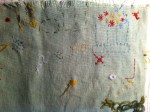
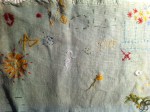
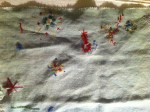
Here are the first glimpses from the Graduation show! what pleases me most, is that people have been in acting with the embroidery and added their stitches to the large cloth which was started at the Event at the Exchange, Penzance.
Soon there will be more photos and reflective writing. The Show comes down on Friday, 21. June.
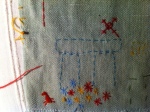
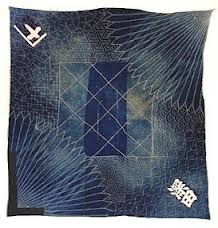
I have been reading in Jane Brocket’s book ‘The Gentle Art of Stitchning’ and came across Sashiko Embroidery. I amfazinted by the imagges of old, traditionalle Sashiko, which was used for darning and embellishing at the same time. I love the look of the worn and faded indigo dyed cloth, embroidered with white cotton yarn. I had come across these images before when I was researching about the Japanese Wabi-Sabi philoshophy . So many aspects of this tradition appeal to me, it the simplicity of the stitch, the matrial and the underlying idea to use it for mending and caring.
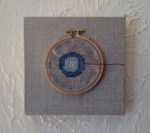
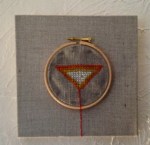
It feels strange, to go home from the college and not being able to take out ‘The Small One’ and carry on stitching. All is done now in the space, the screens are up and running with my films, , the 3 cloth pieces in their hops are laying on an old bench together with the cloth piece of the event ‘Coffee, Cake and Stitch’. On a table are the Stitch Samplers layed out. A small table and three chairs are in the space with the large cloth from the event. There is an invitation to stitch.
For two weeks the three companion piece will be in the space and I feel almost bereft! During the show (Sat. 15. – Wedn. 19.June, 10.00 – 17.00, at University Falmouth, Woodlane Campus) I can work on them for a while.
It is a very strange feeling, almost sudden, even so there was a huge build up over the last two month and now its done, over, finished, in the public eye, scrutinized and judged.
What keeps me boyand and afloat are my memories of the lovely comments on the Stitch Samplers and peoples reaction on the event, and also in conversations.
I will have to start a new cloth, to keep me company!
I was spending a morning with my friend Mark Leahy, a lecturer and performance artist and pondering about the question, why I preferred the term “Stitch” to ” Embroidery”. Mark responded immediately in saying the later one is loaded with associations of decorative, historical, and expectation of skill. In a way I hadn’t really thought about it, only became aware, that I had preferred to use the word ‘Stitch’, calling the project ‘Time and Stitch’ and the pieces of the project ‘Stitch samplers’. The event was called ‘Coffee, Cake and Stitch’. Strangely only on the collaboration with a musician, I had called the documentation ‘Music and Embroidery’. Musing about Mark’s remark, I thought, he got a point; the word ‘Stitch’ feels open and freer, feels free of expectations and I often had to explain this to people, who took part in the project and the event, that I didn’t expect fanciful or skilful embroidery. My emphasis was to share the experience of stitching with other people and inviting them to share their experience with me.
And they did! Through their writing and talking to me about their experience.
Sometimes someone would say “Oh, it is about Cross-Stitch??” and I had to say, that it was about the process and the experience of Stitching.
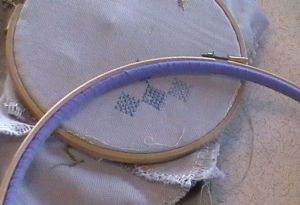
Why do I use Cross-Stitch? I like to stitch with Stitches which cover the stitched surface and are simple. Cross-stitch does that for me; it gives me a framework to work in the pattern, starting in the middle and working my way to the edge. It is simple, I don’t have to think too much about it, can enjoy the rhythm and the movement. When I am on my own, I can pay attention to my breathing and be in the present moment. When in company, I can still share the conversation and carry on stitching.
I was curious what people would stitch and had no expectations. Still I was surprised that no one referred to any pre-fabricated pattern from books, magazines or websites. People really worked with, what they knew and enjoyed and wanted to share.
On the event ‘Coffee, Cake and Stitch’ some people asked me at the beginning: “What do you want me to do?” and I just said:”Stitch!” and they did!
As having receives permission to play with cloth and yarn, it enabled them to enjoy the process and the sharing in company: quite a few said on leaving:”When you do another one (Stitch Event) let me know!”
“Altamira is a sociocultural project I founded in 1998. I have been involved full time with it since then.
With music as a guideline, ALTAMIRA explores through action and reflection the role of cultural issues in the processes of human development.
We think cultural resources vaporization is a mainspring of social empowerment. Our projects thus lean on the link between the art of music and the weakening art of living together.
With Altamira, we explore the link between culture and society, and how it can be a mainspring of social empowerment. Practically, we make community-based records, we set up pluridisciplinary shows as well as cultural interactions of all sorts : open mics, conferences, screenings, etc…
Music is the guideline of these projects, but they are first of all human projects based on sharing and creating together”
I found the website, the text, the whole approach and the aims and the video work very inspiring.
P.S. I will try to figure out how to upload the video to the blog!





















 Rope bracelet








 One Stitch at Time