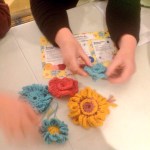
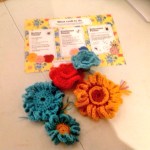
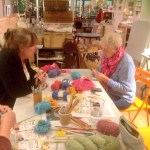
We we were a small group and enjoyed the benefit of getting to know each other better and sharing our crafting stories! It was enjoyed by everyone!

Stitching Alone and with Others
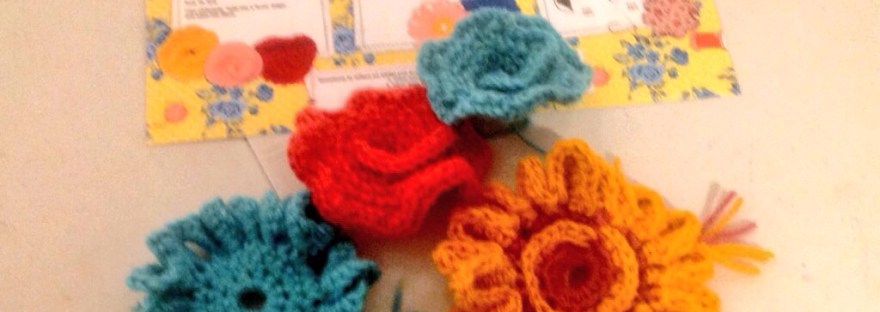
We we were a small group and enjoyed the benefit of getting to know each other better and sharing our crafting stories! It was enjoyed by everyone!


Beginn of this year I became a member of the Cornwall guild of Spinners, Weavers and Dyers.(http://www.cgwsd.btik.com/)
The Guild is holding monthly meeting in Probus and Chacewatter, at the 3rd Friday of a month in Probus is usually a workshop or talk organised.
This month Jean Deane (http://www.cgwsd.btik.com/) shared with us how to dye with Indigo in the most natural way.
Jean is very inspired by Gracia, a French Botanist and Scientist (http://naturaldyeworkshop.com/about/) who has created recipes for natural dying particular for Indigo dyeing.
Indigo for me is now sheer magic! To see the colour of the vat (that is the dye bath), the colour when the wool comes out, still more greenish yellow and then the transformation through oxygen into the wonderful blue!

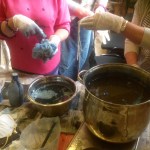
Before hand I had hand spun yarn from the carding waste for this occasion and also dyed some fleece!

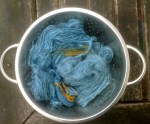
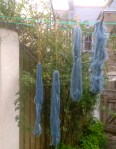
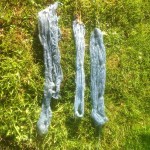
The experience gave me the confidence to work with Indigo, woad and weld at home and with my students at Camborne college.

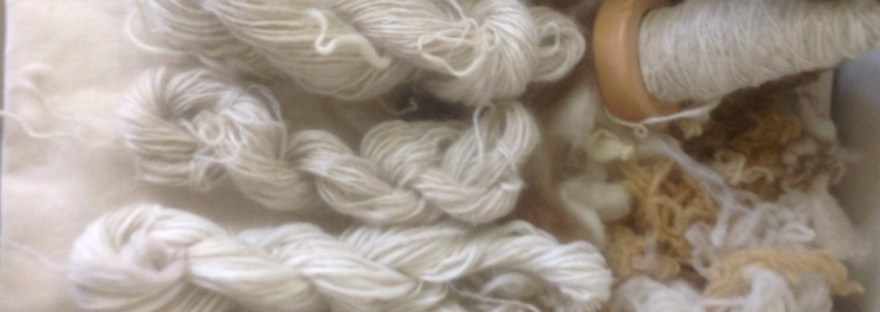
Making Skeins
i spend the morning spinning with this almost white fleece, I don’t know what breed it is as it comes from the carding waste. It has a beautiful lustre when it comes of the cob ( the cob is the wool which comes of the spindle). It was very still and quiete in the studio, the 1. Years are going through their induction phase.
Later on I wound the yarn from the cob into skeins with the help do a niddy noddy. When I mentioned to my partner first that I needed to use a niddy noddy, he thought I was joking and making it up.
Mine came from Carol Grace, retired Textile lecturer and it is a very useful tool to wind yarn into skeins when no helping “arms” are around.
The skeins are the next step of preparation for dying the yarn.
The Guild of Weavers, Spinners and Dyers Cornwall is holding coming Friday an Indigo Dying day and I will attend.
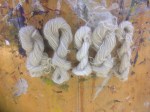
It is quite humbling for me to see the fruits of my labor, by Friday , I will have 5 skein of whitish yarn. I didn’t clock the time, because being with the spinning, the process, the hand movements, which slowly but surely becoming more familiar is what holds my fascination. The feel and the texture of the fleece and the still lingering smell of sheep bring the origin of my material back to me. The memory of an afternoon spend on Bosigran farm, even though we had missed the sheering, the sheep and billy goats were still about.
Working with very little processed wool feels like going back to a source material, something basic and still so essential ……
How does one give a reflective commentary about a meditative and grounding experience? It has to be experience, to be embodied , become part of life………………
The studio is deserted, students gone home, it is still, I can hear the traffic, the late afternoon light begins to fade, I long to be outside with my spindle……..



This blog is a great inspiration for me!
The thing about living in London is that I’m constantly finding out about places and events I’ve never heard of. Although I was a student at UCL, just around the corner from the School of Oriental and African Studies, I’d never been to the Brunei Gallery – until yesterday.
The reason for going was an exhibition called World Eco-Fibre and Textile [WEFT – geddit?] Art, organised by Society Atelier Sarawak of Malaysia. The aim of the exhibition is to show how traditional techniques, including ikat, shibori, weaving, dyeing and printing are being used and developed by contemporary textile artists around the world.
The upper level starts with explanations of techniques. There are particularly good descriptions and samples of Indian embroidery by Asif Shaikh of Ahmedabad in Gujarat. Most are mounted on a karchob – a wooden, horizontal, floor-mounted frame that is large enough to let several people work on…
View original post 374 more words

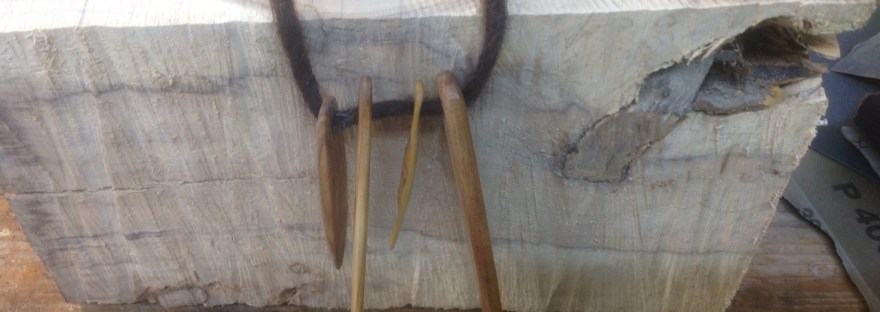


Couple of weeks ago I had meet by chance Justin Duance and his wife Poppy Treffry in Truro. I was working with my hand spun wool and the nalebinding needles. Justin is a jewellery maker and Poppy a textile designer\ maker! both very well known locally in Penzance/ Newlyn.
My work triggered their curiosity and we talked about old techniques and hand making.
I told them that the needles I was using where bought on Etsy, one set from Norway and the other one from North America and I hadn’t found any made in the UK. Also how much I would love to find someone locally who could make needles for me from sustainable woodb(local or reclaimed).
Immediately Justin offered very kindly to have a go, he would have the right wood and the machinery in his workshop. Very gratefully I accepted his offer!
So yesterday I went over to his workshop; I had made 3 cardboard templates and was really exited!
Justin had a piece of yew tree wood and first cut a smaller needle based on my Norwegian needle, I had made it a bit longer and bigger. He cut it out and with the sander brought it into shape !
I then sat down at his workspace with files and sandpaper to finish it of and when it was smooth enough Justin gave it a polish with some Teak oil.
Then Justin cut a thin and longer needle and I finished it off!
It was very satisfying it work with Justin, someone who understands what I am aiming for and how important the aspect of collaboration with local people and using local materials is for me.
I feel truly blessed to have given this opportunity and Justin invited me back to do some more !


Monday, 13. October 2014
Today was a busy day involved with college activities, in the morning I went along the induction of the 3D workshop. Hopefully Andrew will very kindly help me to learn how to make my own Nalebinding needles.
before lunch making friends with the Mac and d projection screen in preparation for my talk to the 1. Years and giving talk after lunch. I appreciate so much to be given the chance to share my enthusiasm for Wool and my thoughts about a sustainable approach in my art practise.
the afternoon flew by and as in walking the talk I need to sit down for a while over a coffee and do some Nalebinding.
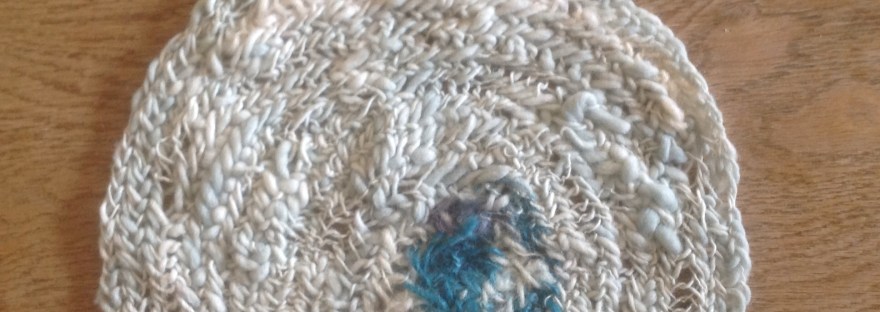
For everyone who’s wondering about Nalebinding, there will be a more in-depth text about the ancient technique soon. For today, Nalebinding is a technique to create a “fabric’ with wool using a wooden needle. It’s predates knitting and archeological find go back to prehistoric times. It was used worldwide, but remained in use predominantly in Scandinavia to make socks, mittens and hats or other small household items. It is closer to sewing and uses a length of yarn at a time. This explains why it went out of use when knitting, which uses a continuous thread.


“Making Things together ”
is a monthly series of workshops/talks in the context of the research project Co-creating Care
Crafting at The Poly,Falmouth with Shane Waltener:
Saturday 22 February: 10.30 a.m. – 1.00 p.m.
Trained as a sculptor, Shane Waltener’s work draws inspiration from craft traditions and processes. He leads co-creation events working with a range of materials and techniques, from Needlecraft to knitting to food crafts, weaving and basketry. Shane describes these as “a conversation through making” that reflects a shared creative journey. His projects are interactive, participatory and fun, as he shifts our attention away from the symbolic meaning of objects and materials to focus on process and the activity of working with them.
Shane will lead a workshop at the Poly in Falmouth on Saturday, 22nd February from 10:30am to 1pm. The event is open to everyone, but numbers are strictly limited, so please sign up on the Eventbright site, add link as soon as possible and bring your ticket with you.
This event is run in conjunction with the AHRC-funded project Co-Creating CARE, which aims to explore the relationship between making and connecting.
For more information about Care: http://cocreatingcare.wordpress.com/the-project/
For more information about Shane Waltener: http://www.shanewaltener.com/
For more information contact Dr Fiona Hackney: fiona.Hackney@falmouth.ac.uk and Mary Loveday-Edwards: mary.lovedayedwards@falmouth.ac.uk

Friday , 10. Oct. 2014
it is quite here on a Friday afternoon, people go home early.
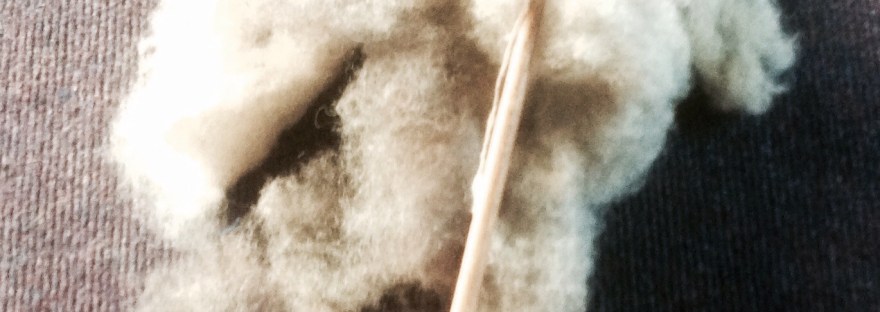
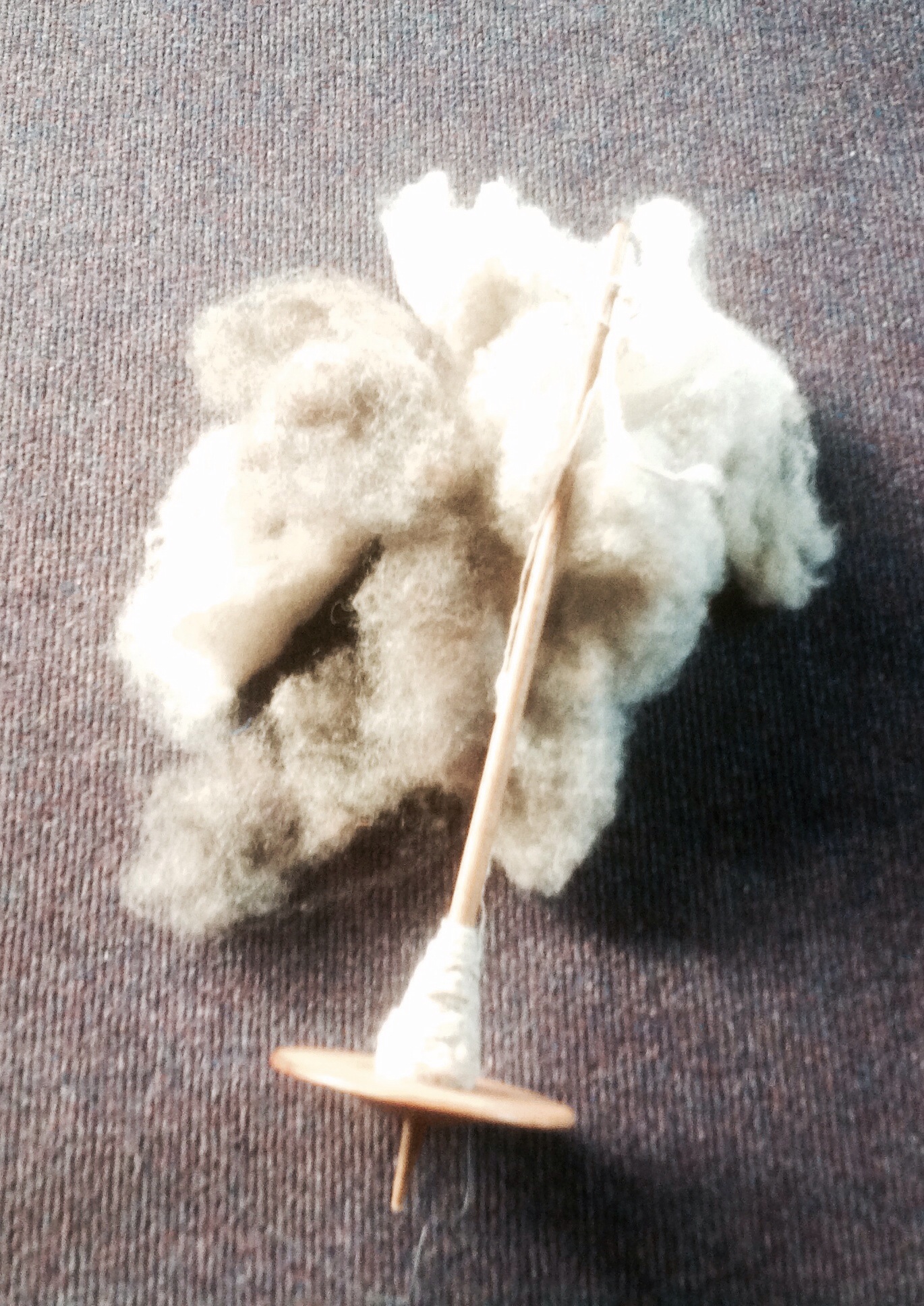
I get lost in the process of spinning.
The rhythmic movements, repeating, spin, draw, wind unto the spindle, spin……. The fleece feels sticky, after a while there is on my finger brown grease residue. The yarn feels rough, I am pleased about a reasonable consistency in the thickness . I realise, I hardly notice the smell anymore.
Another small bucket full of fleece is washed and will dry over the week-end.
alongside I am listening to some Scandinavian or far more correct Sami music, Joiks, songs often with out words.
Spinning and listing to ancient music evokes a strong sense of appreciation in me. We are linked with our ancestors and in rediscovering these old links we can strengthening our sense of belonging to this earth.


Today is my 2. Day on my residency at Camborne College. I will keep a diary throughout my time here.
I appreciate so much to be given the chance to share my passion about wool,particular local and British with the students on the BA Conteporay Creative Pracises.
Friday, 10. Oct 2914
I am officially here now, with tag, email and internet log in!
Monday was my first day and I arrived with 6 sacks of wool!
The wool ranges from a Shetland fleece, I was given earlier this year for my birthday ( in conjunction with a lovely old spinning wheel), fleece from Bosigrian Farm on the North Coast of Penwith and carding discharge from the Natural Fibre Company in Launcton. Along side a big bag with spindles, carders and a niddy noddy ( skein winding tool, no joke! ).
Today, like Monday, I am washing the Shetland fleece, bit by bit, soaking with laundry detergent, rinsing, putting into a washing machine to spin and let it try.
In between I have picked out some fleece and I am carding it “in the grease” meaning unwashed. This is a very new experience for me, my hands love it, all the lanolin!
Today I will try to spin some of the raw wool.
The whole process give a strong in depths feeling to the material.
My thoughts wander to times when this was nessity for clothing people…….. Every piece of clothing we wear, starts with a spun thread….


Nalebinding – My Daily Practise


living in the moment, breathing into the presents and making to feel alive
Fibre Art, Eco Printing, Natural Dyeing, Book Arts
A Journal of Observations
wherever the spinning takes me
Ceramic Artist and Potter
The Multi-Award Winning Knitting, Comedy and Yarn Podcast
CELEBRATING THE BEAUTY OF SUNSHINE COAST MUSHROOMS
Finding the beautiful in the everyday
adventures in learning to sew
Songs with a smile and a heart


 One Stitch at Time